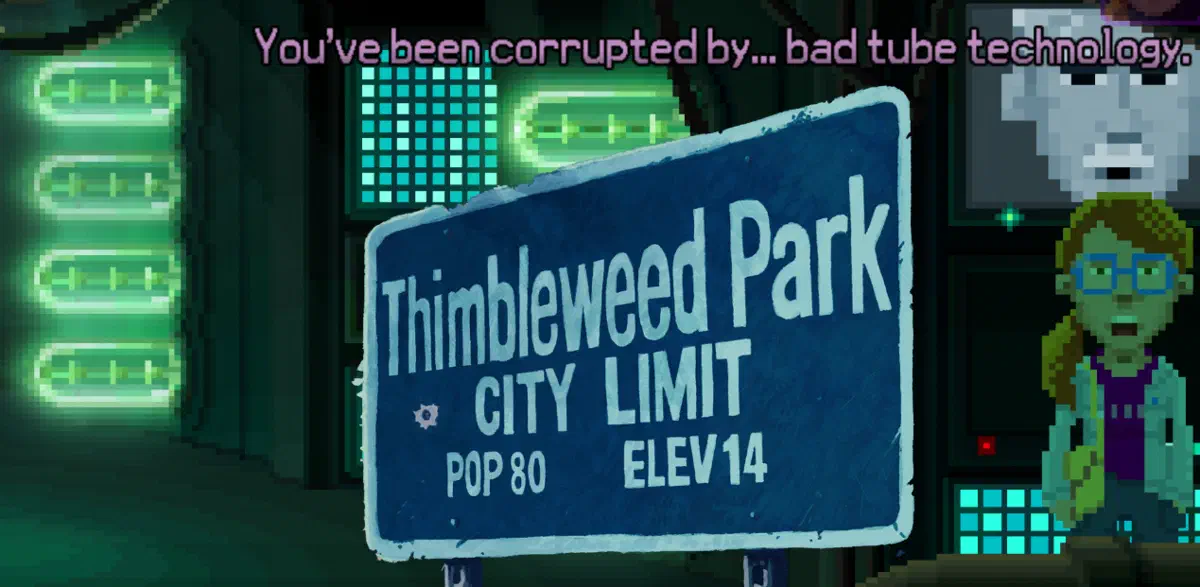
Thimbleweed Park is a 2017 point-and-click adventure released by Terrible Toybox. For those familiar with the classics of this genre, it is a return to the genre by classic game creators Ron Gilbert and Gary Winnick. This is, for those in the know, a Big Deal: Consider it akin to a cinematic Western revival getting Sergio Leone and Ennio Morricone to get back together for one more film. (Ignore that both are deceased.)
Thimbleweed Park draws a lot from two formative games of the genre, 1987’s Maniac Mansion and 1990’s The Secret of Monkey Island. I’d say Maniac Mansion is the larger influence here, but that series only had a single sequel, while Monkey Island has several sequels advancing art styles and technology, including an episodic Tales of Monkey Island miniseries (released during a period of interest in episodic gaming in the late 2000s) and the most recent game, possibly approved due to Thimbleweed Park, by Ron Gilbert and associates in 2022.
Point & Click Adventures #
For those not familiar with the genre, point & click games were a development from earlier Text Adventures. Text Adventures used a simple parser to interpret commands like:
You are in a dark jungle. You are likely to be eaten by something.
>GO WEST
You travel west and encounter an angry monkey.
In short, text adventures were a somewhat unusual example of a command-line interface: Users entered commands which the computer interpreted. Some games supported long, complex commands: one walkthrough for the popular Hitchhiker’s Guide to the Galaxy text adventure suggested a long, multi-sentence command to describe a complex action requiring very specific timing.
This command, it should be said, may have been trying to mess with players.
Command Line Interfaces (abreviated CLI) have undeniable utility, especially as ’expert tools’ so an obvious next step was adding images and a more user-friendly Graphical User Interface or GUI. Some early games like Mystery House had images, but they were more like references to view than interactive scenes.
The point-and-click games evolved to use GUI concepts in an era in which the GUI was rapidly developing, with MacOS and early Windows just two of many systems experimenting with allowing suers to manipulate data in a more visual way. This amde games more accessible for the same reason most computer suers prefer some variat of a GUI for most ‘general purpose’ tasks: A GUI is hopefully intuitive, open to exploration, and provides a level of direct feedback.
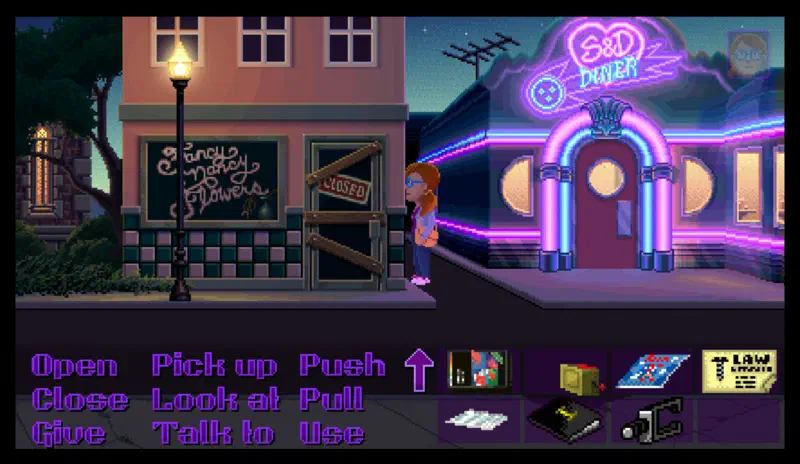
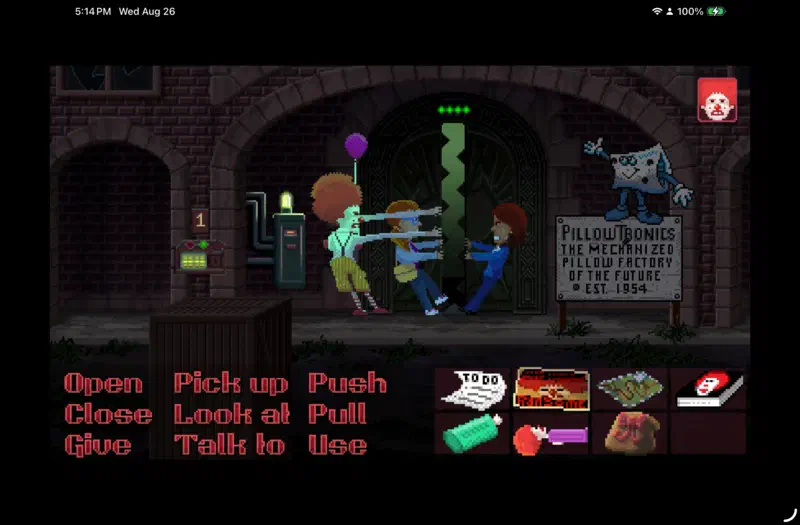
Thimbleweed Park’s interface is inspired by the earlier games. The bulk of the screen is a large, clickable representation of a ‘room’ or area being explored. The earliest of the early adventure games used crude graphics with strict limits, while later games took advantage of improvements in computing resources to add more detailed, painted interfaces. The modern engine used in this game added support for various special effects and camera movements.
The interface has moving characters and objects that can be clicked on. In the above I’m controlling Dolores, arguably the most important of the game’s five controllable characters. The player clicks and the controlled character walks over to things they can interact with.
The lower right of the interface shows the player’s inventory. The lower left is a set of ‘verbs.’ Essentially, selecting a verb (“Open”) and clicking an object (A door of the defunct florist) is similar to the earlier text adventure’s common commands: “Open Door” for example. The game can give feedback or trigger brief animated scenes to show what is happening.
(There’s a small near-invisible control in the upper right with the active character’s portrait: A scenario-specific aspect of Thimbleweed Park is as many as five playable characters depending on the point in the story, and this menu allows switching between them as well as access to the the necessary game menu.)
As I said earlier, it’s a simple intuitive interface. More importantly, Thimbleweed Park inherited a trait found in most LucasArts games of trust and respect for the player.
Trust and Respect #
I feel like a key aspect of most of the LucasArts classics and Thimbleweed Park is that the games’ designers have spent a lot of effort to prevent a ‘soft lock’ or un-winnable situation. This includes ‘game overs’ and cements these games as experiences as much as games in my opinion.
There is always a way forward for the player.
I remember an era in the mid 2000s where Flash-based ‘Escape Room’ and short adventure games were popular. An issue I always had with these was a lack of trust: You never knew if the developer just hadn’t tested the game properly or you were running into a weird Flash bug. Was the player just missing a solution, or had And that’s ignoring the related rise of games that trolled the player with jump scares and similar.
Investing in a game that you don’t trust is difficult and unfulfilling. And I’ve put up with a lot: My current setup for some PC games is a Linux box, but streaming via Steam to a Mac to get audio without weird issues. (Yes, my setup is weird.)
The other linked aspect I am compelled to mention is simply respect: Good designers understand the difference between padding and more content. Repetitive tasks aren’t fun. Making interesting decisions is fun, be it rapid-fire decisions in a shooter game or slower, more methodical exploration and problem solving.
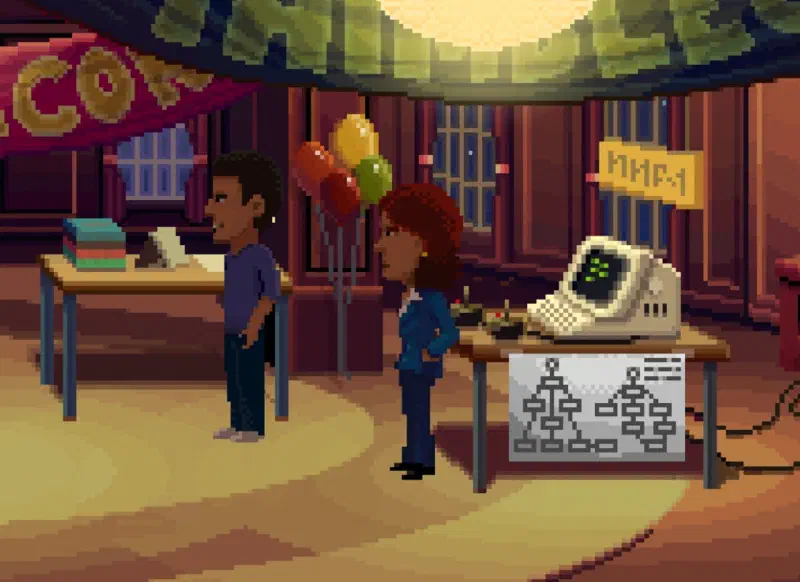
Lead designer Ron Gilbert maintains a long-lived blog that goes into his design philosophies. I recommend it: He really does try to apply a methodology so that his games are fun. Some
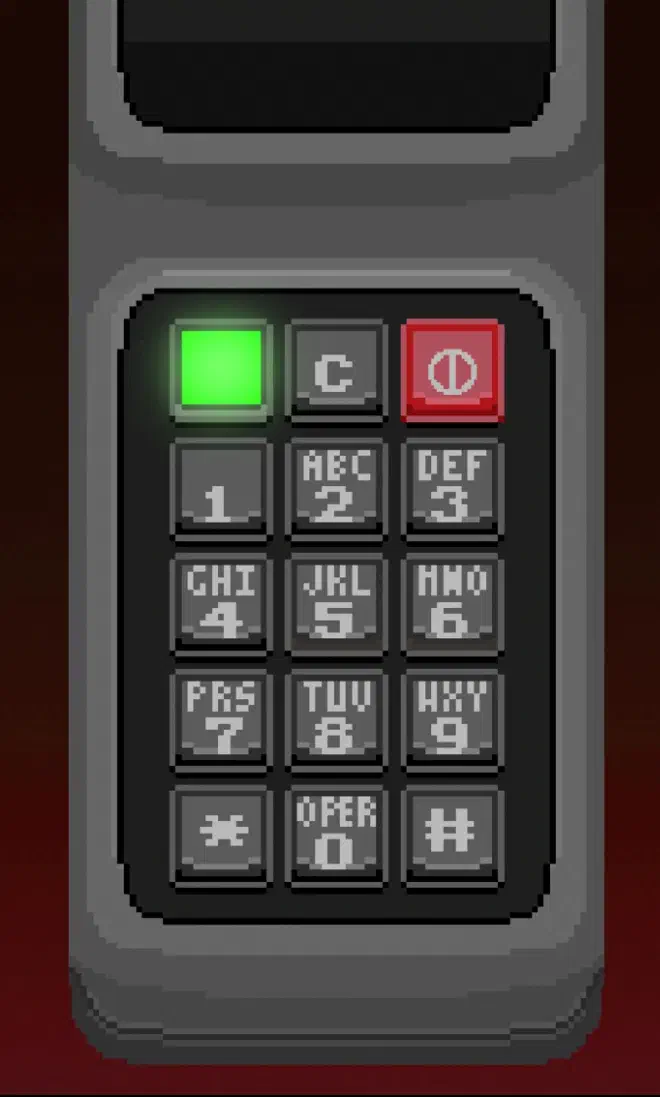
Conveniently, one character even has an era-appropriate cell phone!
The hint system isn’t perfect, but it does keep players “in the game” in my experience.
Yes, 80s Nostalgia is a Thing #
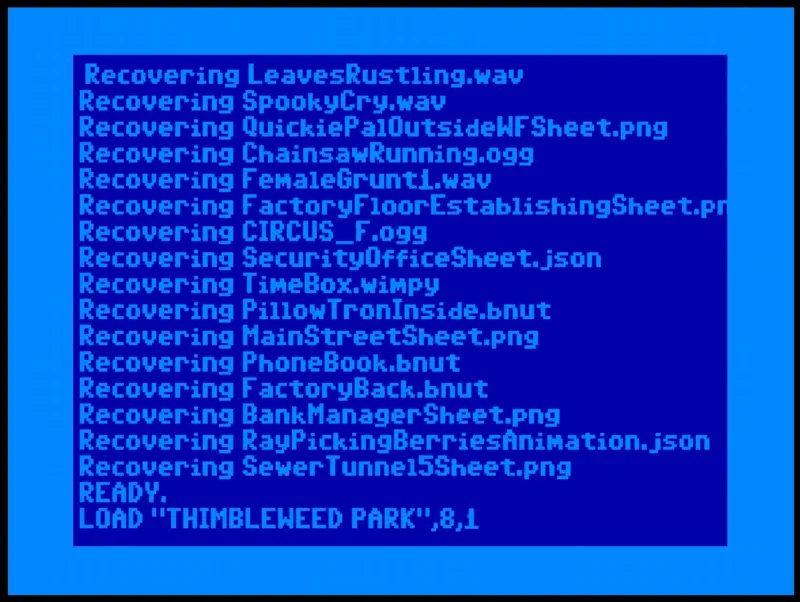
As if Stranger Things and similar wasn’t a hint. #
Set in 1987, the story of Thimbleweed Park unsurprisingly evokes a range of 80s tropes but also a commentary on adventure games and the games industry of the era. The graphics themselves are an intentional call-back to earlier games, but importantly they’re also a conscious decision that those games used oversized heads to make best use of limited animation capacity.
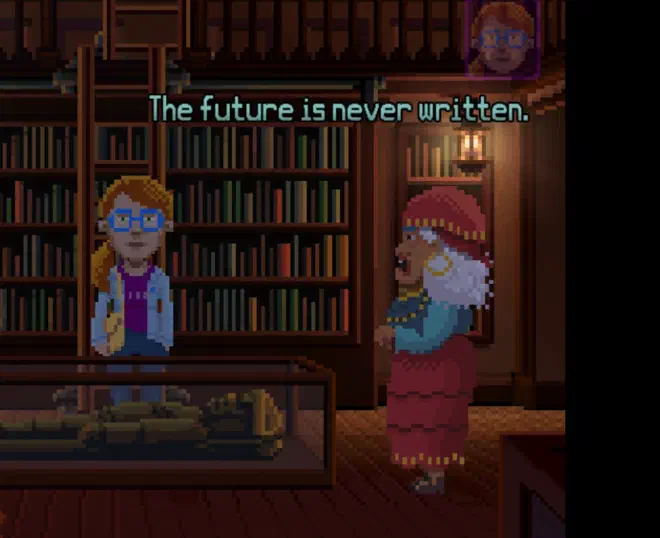
The plot unwinds in a fun way: Initially the player controls Agent Ray and Agent Reyes, two agents investigating a murder. Each has clearly different hidden goals shown clearly by each having a to-do list. They’re joined by the previously mentioned Delores, her father Franklin, and a slightly disturbing cursed clown. Each has their own goals, abilities, and limitations. Delores is interested in computers, so a great choice for a lot of ’tech’ abilities, while the agents handle ‘forensic’ tasks and similar. Despite all characters being under player control, they all have individual objectives and dialog.
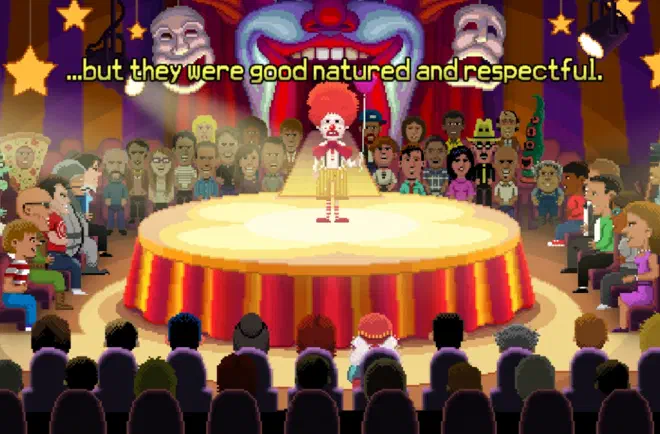
Ransome the clown is introduced in a flashback where he’s cursed to never be able to remove his makeup. He’s a foul-mouthed character: They sell a DLC that removes the censors on his dialog. (Or it’s a joke, perhaps.) He’s somewhat less than univerally liked based on message boards but his story clearly establishes the setting of the game does include some supernatural elements.
I don’t want to spoil the game’s plot further. but I do recommend those with memories of the classic point and click adventures give it a try. It’s a delightful adventure.
A few areas have ‘mazes’ int hem that I find annoying. I think this is intended as a sort of meta commentary, as one is essentially skippable or usable to move through an area with only a few real ‘rooms’ while the other has puzzles connected to make it easier.
Gilbert also did a brief follow-up in 2020 featuring Delores. My understanding is this was basically a sort of tech-demo/sanity-maintaining project, mostly using existing assets from Thimbleweed Park to tell a brief side story.
IOS Notes #
I played Thimbleweed Park most recently on IOS, which was convenient during some recent travel. It’s well-designed for mobile, at least on my iPad Mini. Playing on a phone seems a little miserable, but some may find it the best way for them.
Sadly the current version has a tiny bit of digital rot, probably due to years of regualr IOS updates including new windowing models and similar. I have no idea if the recently announced Thimbleweed Park 2 uses a similar enough engine that there’s incentive for a bug fix to an older game, but it wouldn’t hurt.
It’s very playable, but the IOS clock and top indicators were always visible, as was a small semi-circular corner element. Quitting the game was difciult, sometimes requireing invoking the IOS ‘menu bar’ and using the classic MacOS stile File -> Quit menu ite.
Final Verdict #
Play it! If you enjoy humorous, clever games with a lot of heart behind them, this is one: It’s a triumph for a small team crafting a memorable experience that respects the player.
As with many games of this type, exploration and discovery is the key. The developers did their job but you need to look around to enjoy it.