Starting in the Beginning #
“Where to begin” is a bit difficult question if we are not allowing a Conspiracy board:
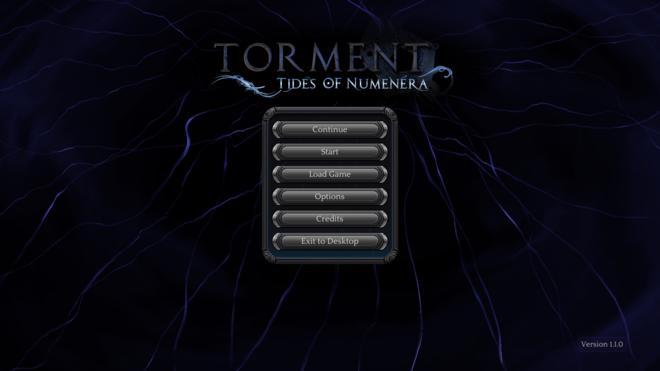
Numenara is a tabletop RPG setting that led to the founding of Monte Cook Games. Developed alongside the tabletop RPG was the 2017 computer game Torment: Tides of Numenara (Hereafter just Torment).
But, wait… #
That’s not really the start, though. Many stories, much like the story Torment tells, are messy things. Beginnings and ends are difficult.
The Numenara setting is a spiritual successor of sorts to the Dungeons & Dragons 2nd Edition Planescape setting. Planescape, as well, was an attempt to make a selection of well liked but perhaps unorganized aspects of the Dungeons & Dragons game more accesible and interesting.
Welcome to the AD&D® game’s closet.
So early D&D drew a lot of inspiration from sources beyond the typical ‘Tolkien-esque’ fantasy. One predominant view of the worlds beyond the ‘regular’ world was presented in the Manual of the Planes (a 1987 D&D sourcebook that opens with the closet quote, above). This book codified “the Great Wheel” a model where a multitude of different Heavens and Hells coexisted in a round arrangement with other worlds inspired by mythology and fiction existing in a complex network.
A problem with the Manual of the Planes era material is it could be interpreted as somewhat unfriendly to player characters and a bit uneven. Several planes were very hostile to unprepared explorers (and low-level characters), encouraging the flavor of ‘system mastery’ common in that era if D&D in which players were rewarded for reading books of setting material instead of exploring within the game. This is not to say that the Manual of the Planes is a bad book, but merely a difficult attempt to catalog not one but many infinite spaces.
Writers more knowledgeable than me could also detail how this attempt to catalog and define other planes of existence informed a general vibe in a lot of media of the era with alternate universes and planes with strange properties.
IN D&D’s 2nd Edition era (1989 - 2000) the Planescape setting was an effort released in 1994 to review the previous material on other worlds. It made efforts to establish that even dangerous places could be explored by clever lower-level adventurers. Planescape provided the city of Sigil, a sprawling impossible city that had countless portals (known and unknown) to fantastic settings and made travel to those worlds easier.
This setting led to 1999’s Planescape: Torment which will likely eventually be reviewed here. Planescape: Torment shares an engine with the earlier Baldur’s Gate and Icewind Dale games, but dramatically reinterprets aspects. It takes a great deal of inspiration from point & click adventure games, favoring conversation and interaction voer outright combat. The player can make decisions and must pay for their decisions. They have a single protagonist with several companions each of whom provide different views on the protagonist’s adventures.
Spiritual Sequel or Sequels #
Planescape: Torment is widely regarded as one of the best cRPGs of all time and will hopefully get a review here at some point. Despite this it did not receive a sequel.
It did receive two spiritual sequels. In 2015 Pillars of Eternity was released and provided a somewhat more ’traditional’ fantasy experience. I hope to review this game as well, but in general I felt like this was a more traditional fantasy world albeit with some unusual aspects. This did receive DLC and a sequel as well as an action-oriented spin-off game.
The second spiritual successor was Torment: Tides of Numenara which ended up using the engine from Pillars of Eternity. To me it feels much more like the earlier Planescape game despite being very different. Understanding many design decision in Torment requires understanding the Numenara setting.
Planescape: Torment is the story of a man known as The Nameless One who awakes in a mortuary of a strange, baroque, dirty city called Sigil, an undeniably central location of the Planescape setting. He sets out on a simple quest to recover a lost journal, but this quickly spirals into a philosophical exploration of the value of immortality. The game only leaves Sigil’s twisting paths on brief jaunts, but Sigil is diverse and interesting enough that this is not a problem.
Numenara, the Ninth World #
Numenara owes a lot to the fantasy & science-fiction works of the 1960s when the two genres were much less distinct. It’s described in the tabletop material as a setting where the common tropes of pseudo-medieval fantasy seen in tabletop RPGs may make sense as everything is built on the remains of previous civilizations. ‘Magic’ may be ancient technology, and characters may repurpose ancient artifacts: A power cell from a strange device might be sued as a simple light source or exotic liquids scavenged from a device might give temporary superpowers.
It is a world that favors exploration. The tabletop rules were named the ‘Cypher System’ with Cypher used for various single-use items that the PCs will discover. The tabletop and cRPG even have mechanisms (different in each) to discourage hoarding these Cyphers.
(Planescape: Torment had an issue with the latter. There were a multitude of minor magic items that were a simple single usage of a spell, and I’m sure I’m not alone in hoarding these for late-game “just in case.”)
Torment is set far to the east of the Numenara setting as described in the book, and much of the game is set in the city of Sagus Cliffs with sojourns to various other reasons including a large segment spent in a disgusting undercity that is a living creature. It was developed alongside the tabletop world and ‘feels’ a bit more science-fiction based than the tabletop material suggests. Still, Numenara is a massive world that is built on the remains of other civilizations, so different regions can certainly have different themes and feels.
Comparisons to Planescape: Torment may seem obvious: A protagonist known by a description instead of a name explores an RPG world that isn’t a giant sprawling globe but instead a single sprawling city filled with unusual and amazing things. This city is a backgroudn for exploring questions of mortality and morality intertwined.
Will players enjoy their time in Numenara? #
Players in Numenara need to be open to a setting that draws heavily from works from creators such as Mœbius, Alejandro Jodorowsky, Gene Wolf, or China Miéville. It is a setting where the player is constantly confronted by new and unusual things. It is a setting that encourages exploration and experimentation and I feel the translation to a computer-mediated game mostly maintains this stance.
The earlier Planescape material tended to be a ‘deep dive’ into Dungeons & Dragons lore. As was mentioned earlier, the setting grew out of taking a collection of oddities and adding a framework to make them a bit more friendly to exploration. Still, Planescape undeniably rewards players who have memorized obscure details of the game: Vulnerabilities of various demons, devils, and other monstrosities; The classification of magic spells and how different worlds modify them; Knowledge of the layout of more than a dozen exotic worlds. Additionally, of course, the “systems mastery” of AD&D 2nd Edition which could be somewhat baroque at times.
I feel like Numenara in both tabletop and computer versions tries to avoid this scenario, favoring ‘doing’ over ‘knowing’. Sure, a player may know background about a region but there’s an expectation that the game will have unique places to explore, cyphers, and similar. Numenara isn’t about trying to detail the game world in detail but portray a sense of wonder that is open-ended and can adjust to the players.
Onto the Torment #
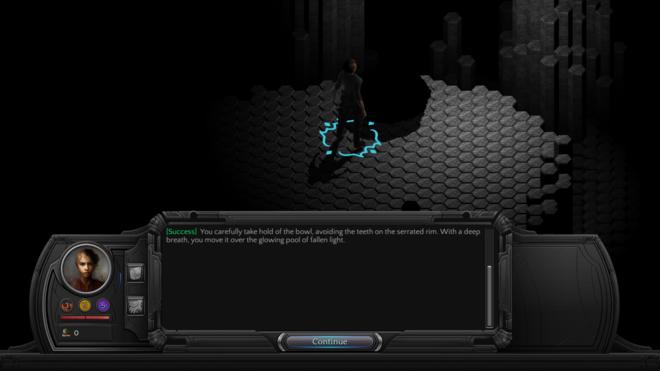
So the actual Torment game focuses on the player stepping into the shoes of The Last Castoff who, in the initial ‘character creation’ sequence, finds his or herself plummeting to the earth. The player can have their character die in this early segment, if they wish. (It’s worth an achievement!) They end up in their mindscape, a place full of shifting hexagonal floors and dramatic lighting. This is basically the “Personality Quiz” form of character creation. I respect that you get to review and change your choices later on.
After this segment the Last Castoff is tossed into the plot. The story is told by via dialog-heavy scripted elements. The similarity to the much earlier Planescape: Torment and related Infinity Engine games is easy, and one important aspect similar to the Nameless One’s adventures is the player is given an option to lie.
Only select games really have this, I feel: It was novel when Planescape: Torment was released, less so now. I think some games like Mass Effect (which is arguably a distant cousin due to shared ties to developer Bioware.) have sued this conceit, often tied to the “morality system.”
Both Torments have a sort of morality system where player actions change ‘obscured’ values that impact things. The D&D-based game, unsurprisingly, uses the D&D two-axis alignment system that has been the subject of debate since at least it’s first publishing. Torment uses the ‘Tides’ referenced int he name, which are color-coded emotional states and are tied closely to why The Last Castoff is important to the world. Dominant tides may open up options when interacting with other characters or various objects. Going too deeply into the Tides would be a minor spoiler for the game and is against the Numenara setting’s spirit of exploration, I recommend anyone who wants to play this game to just do whatever they feel makes sense for their character and not worry about trying to maximize one Tide or another.
Torment is a story of exploration and dealing with the protagonist’s unusual heritage. Their name/title is because they’re the newly vacated remnant of an entity known as The Changing God who abandoned their body when it became convenient to do so. As the player explores they find many other castoffs who have similar experiences: Some worked with their father as assistants in strange experiments, others were merely discarded because they were no longer useful. Most have strong opinions on the Changing God that shape their interactions with the player. The earlier Planescape: Torment is about a character that cannot die and the curse this has become: Torment: Tides of Numenara is a character once-removed from the immortal (albeit very hard to kill) who desperately needs to know their place int he world and their relationship to their immortal sire.
Mechanics of Torment #
The game uses the Cypher System, which simplifies character statistics to 3 key statistics (Might, Speed, and Intellect) which have a simple rating. These aren’t just statistics, but pools, which can be spent to improve the chances to succeed on a roll or improve effects. These pools also have an associated Edge score, which makes it cheaper to improve them.
The use of just three pools bothered many people, but generally works in play. The importance of minor items to replenish pools can’t be overstated: A warrior might burn through their Might Pool in a series of combats and related tasks where muscle is required, so having something stashed to restore that pool is very helpful.
The game is turned-based for combat. Sorry, for crises. The term Crisis is used as a reminder that most combats can be avoided or have an alternate route beyond simply defeating opponents in combat. Much like Planescape: Torment locations have various things that can be inspected or interacted with: These remain active in Crisis mode and can often be used alongside talking to opponents to provide alternative ways to resolve the conflict.
The turn-based gameplay can slow things down, especially in a few situations where there’s a lot of opponents in play.
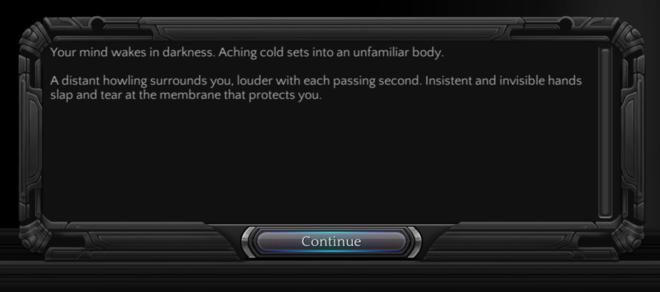
The game is text-heavy with lots of interactions (including conversation with other characters) often resulting in long stretches of exploring dialog trees. There’s even a sort of secondary dialog-tree interface used for specific encounters where the whole screen is taken over by the interface. A few other games (Like Rogue Trader) use a similar conceit but Torment uses it for a very specific plot-relevant situation.
The game has a good bit of exploration, but does restrict the player to various areas at times. You cannot rely on always being able to go back to past locations. I feel there’s a strong desire to give the game replay value. Many character skills and abilities open or close various paths to complete goals.
When exploring, a nice feature is that while The Last Castoff generally leads, tasks can be delegated. An interface shows the percentage chance of an action succeeding: A character focused on quick wits might delegate lifting a heavy object to a brawnier companion. The character attempting the tasks may spend points from the relevant Pool to make the attempt more likely.
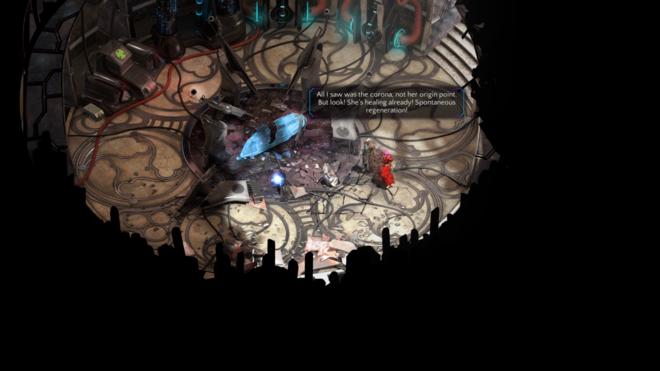
The mechanics lead into scenario design, and I feel a great deal of effort was spent to make the game impossible (or at least very hard) to wedge into an unwinnable state. Failed tasks often open new paths or reveal interesting things: If a player fails to lift the heavy object mentioned earlier, they might discover they can tug a key item free, or that there’s some tool nearby to make the whole thing easier.
Torment to Torment #
The earlier Planescape: Torment is a classic for good reasons, but I can’t help but think that one of those reasons it is so favored is that it broke several game tropes and helped clear the way for many less “traditional” fantasy cRPGs. It ran so other games could walk. This makes me think that some players may not find the earlier game as exciting as it doesn’t feel as innovative now.
Torment: Tides of Numenara refines many of the concepts, but I’m not sure if it feels as innovative. It’s an interesting world, but it is a world formed from many parts with no sense of cohesion. The ‘alignment’ of the Tides probably didn’t feel that different to people used to games like Knights of the Old Republic where there’s a strong, clear ‘alignment meter’ of sorts in play.
Summary of Torment #
Despite my concerns, I think this is a good game and worth playing. It has a unique and interesting setting which helps me overlook the slow pace of turn-based combat. It seems to be ’tuned’ to not be overly difficult, encouraging players to experiment.